
What Arum palaestina taught me about ancestral memory.
My 12-year-old son and I were hiking with some friends at Big Sur Land Trust‘s Marks Ranch when TJ fell back from our group. I found him squatting next to a cluster of what looked like lily leaves – broad, veiny sheaths opened flat to the sun. Among them was a solitary flower in bloom, a singular aubergine petal elegantly wrapped around a tall, thick stamen.
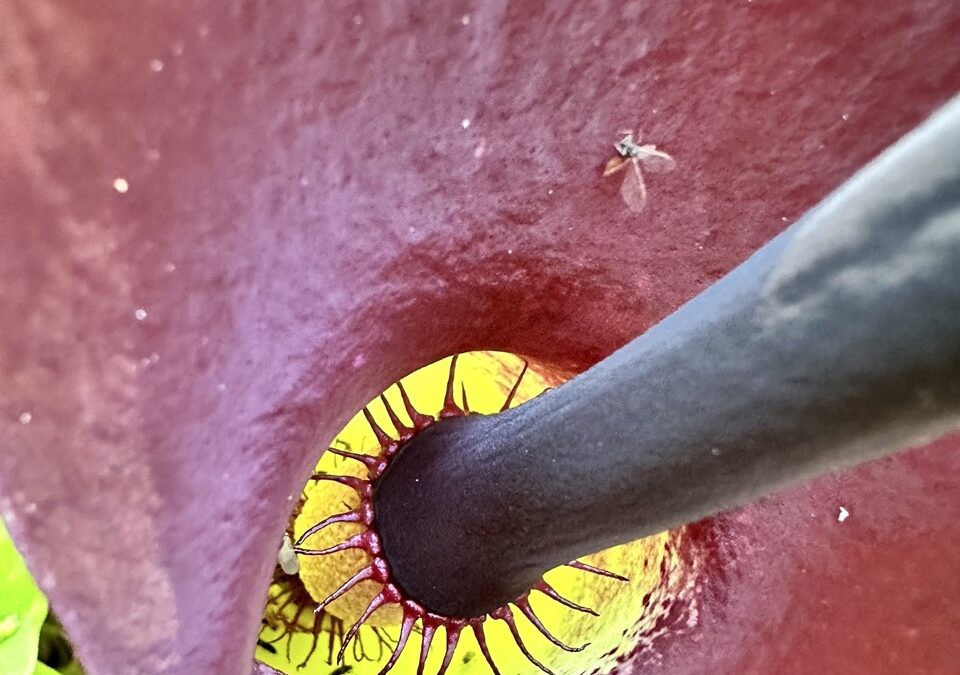
My kid was peering into a translucent pitcher at the base of the flower. Tiny flies bumbled around inside the chartreuse chamber under a formidable ring of purple spines. TJ theorized this was a carnivorous plant. I was pretty sure it was a lily, and not carnivorous. My friends puzzled over it too, and I promised to find answers. As a former environmental journalist, I love a good plant mystery.
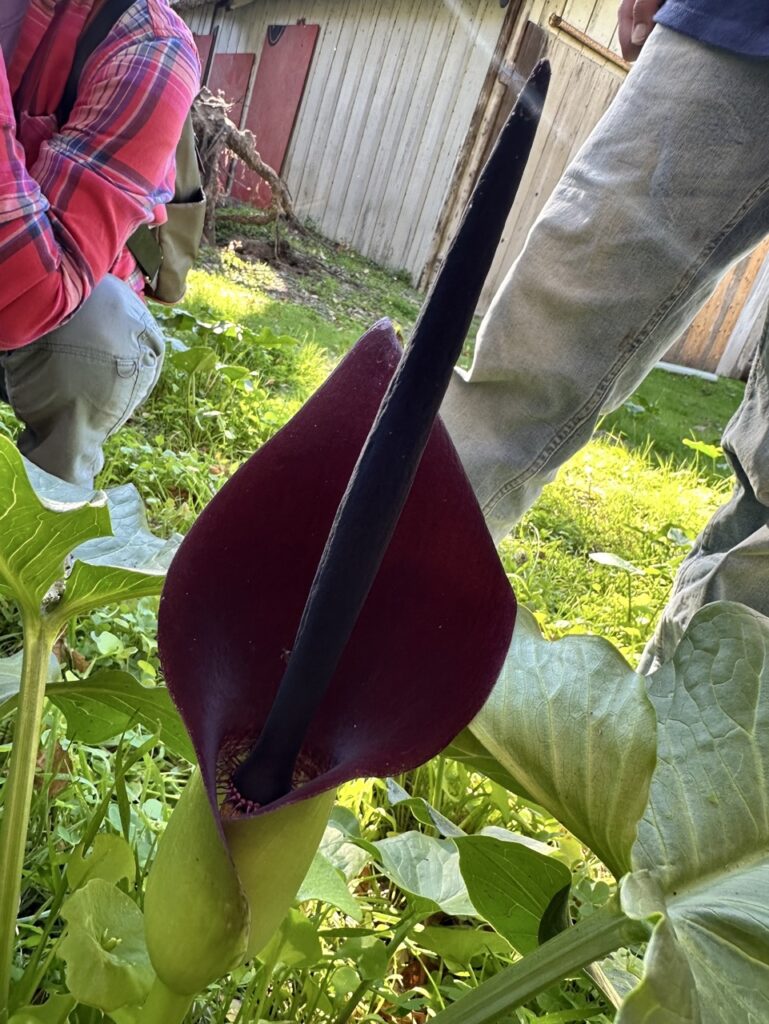
Later, with help from iNaturalist, I identified it as Palestine arum (Arum palaestina), aka Solomon’s lily, black calla, noo’ah loof. The flower emits a scent of rotten, fermenting fruit, luring vinegar flies (Drosophilidae) into the lily’s slippery calyx. The flies find no nectar there but are trapped by a ring of downward-pointing bristles. The lily doesn’t consume the flies; it releases them the next day – covered in pollen, which they carry to the next arum. (Thanks to Max Planck Institute for Chemical Ecology for unraveling this mystery!)
The plant encounter moved me for a few reasons. My kid and I were both partly right: It *is* a lily, and it *is* trapping the flies. What a clever design! And we were lucky to experience this particular, fleeting bloom. Palestine arums flower once per year, and only for a few hours.
The plant’s origins are a connection, too. Palestine arums are native to the Levant, where they have been used as food and medicine for millennia. My own ancestors lived among these plants. I like to think this encounter triggered some glimmer of “plantcestral remembrance” across generations (a concept explored in Layla K. Feghali’s book, The Land in Our Bones).
Have you encountered a plant that made you pause and marvel? Or one that made you feel connected to your ancestors? Tell us about it in the comments.